Research
My research focuses on understanding the link between mechanical properties and electronic properties in molecular semiconductors through precision measurements on the nanoscale.
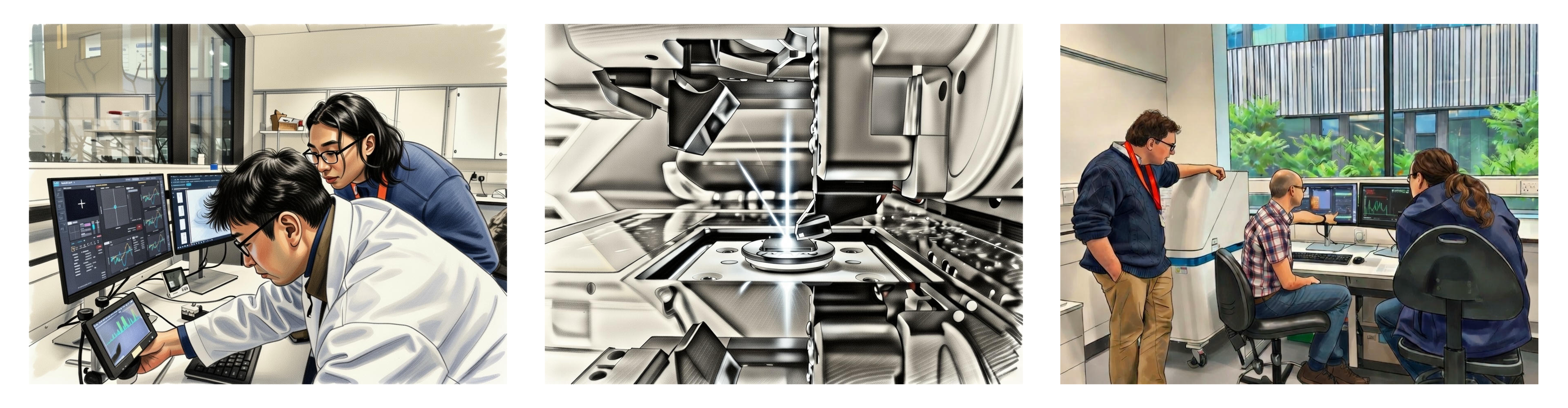
We implement cutting-edge force mapping techniques using atomic force microscopes to study molecular semiconductors across temperature-induced phase transitions, at cooperative phase transitions, at reduced dimensions, at the limits of charge conduction, and through newly designed electromechanical devices. We also attempt to measure how elasticity in the solid state emerges ground-up from the single molecule level. We use high-resolution measurement techniques based on multifrequency intermodulation, higher eigenmodes, and quasi-static indentation, to visualise contrast on the scale of a few nanometres, in both topography and elasticity.
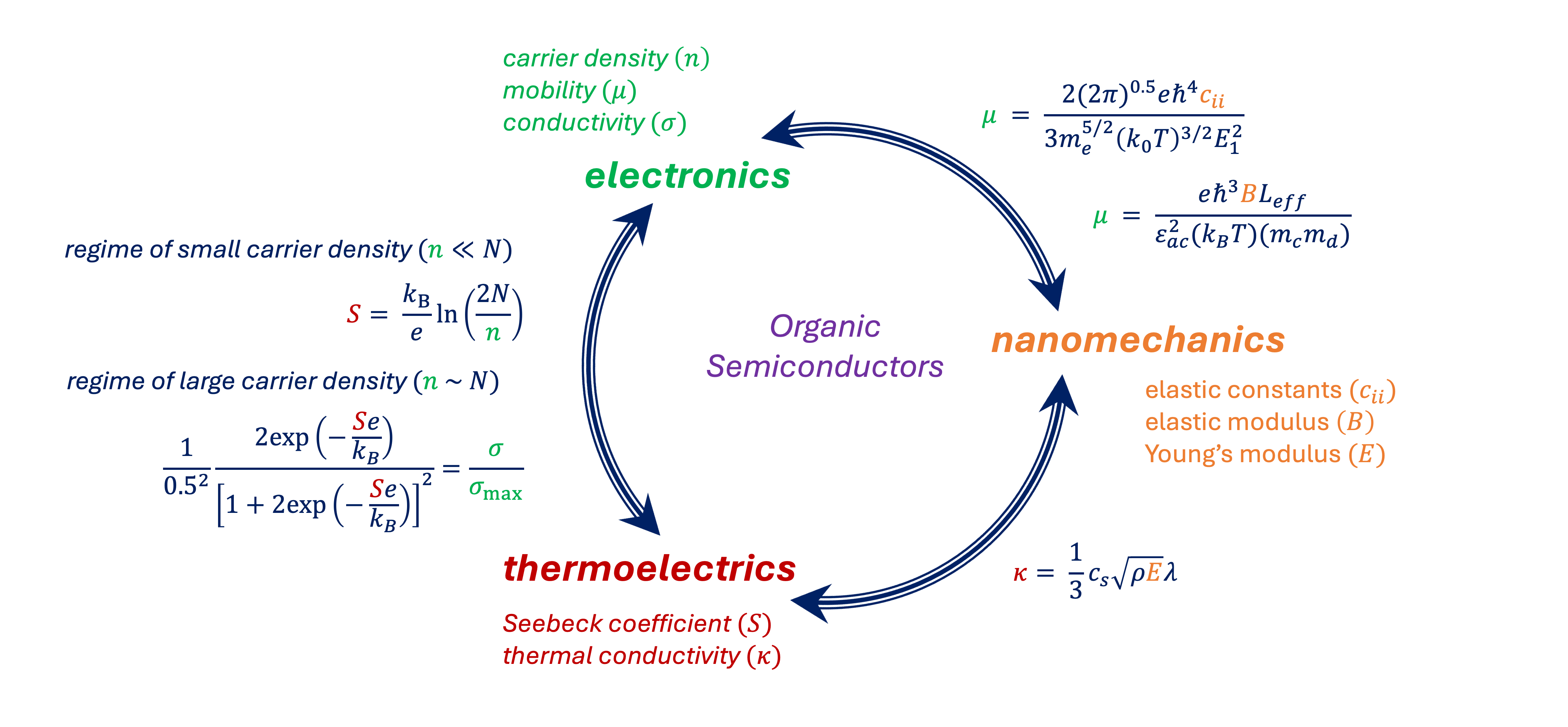
Through experiment, we attempt to build a framework (should one exist) that interlinks the properties of mobility, conductivity, Seebeck coefficient, and elasticity within organic semiconductors. Such an understanding will contribute to fundamental knowlege of the physics of multi-functional molecular materials. One proposed framework is summarised in the schematic diagram below.
Research Consortium
I run my research program jointly with collaborators in Cambridge, Dr Ki-Hwan Hwang and Mr Mateo Cervantes, and with collaborators in Stockholm, Prof Per Claesson and team. We profit from strong industry ties through an academia-industry partnership with Park Systems. On theory and calculations of molecular mechanics, I work with Prof Erin Johnson and Prof Yoann Olivier.
Beyond electronically active materials, we collaborate closely with Prof Ljiljana Fruk and Dr Leszek J. Spalek to expand the systems we study to include biological matter.
My work is funded in most part through research grants I hold from the Royal Society for which I am deeply grateful.
Since 2024, I jointly run a new program on molecular thermoelectrics with Dr Guillaume Schweicher at ULB in Belgium and Prof Kazuo Takimiya at RIKEN in Japan. The program was seed funded by the Wiener Anspach Foundation.
A small part of my research program is completely blue skies. One example of this is to treat nanoscale topography information topologically, and apply novel tools such as Topological Data Analysis (TDA) and Geometric Data Analysis (GDA) to evaluate atomic force microscopy images. This work is funded in part by the Royal Society and in part through UNAM in Mexico. It is conducted together with Prof Pablo Padilla.
On the topic of collaborative teams, I remember the words of my late mentor Prof B. S. Chandrashekar, “As in life, so in career. People may come and go. In the time we spend with them, they will undoubtedly leave an indelible imprint on us. Be a friend of the world, stay curious, and walk through life believing you have something to learn from all who cross your road.”
I very much live by these words.